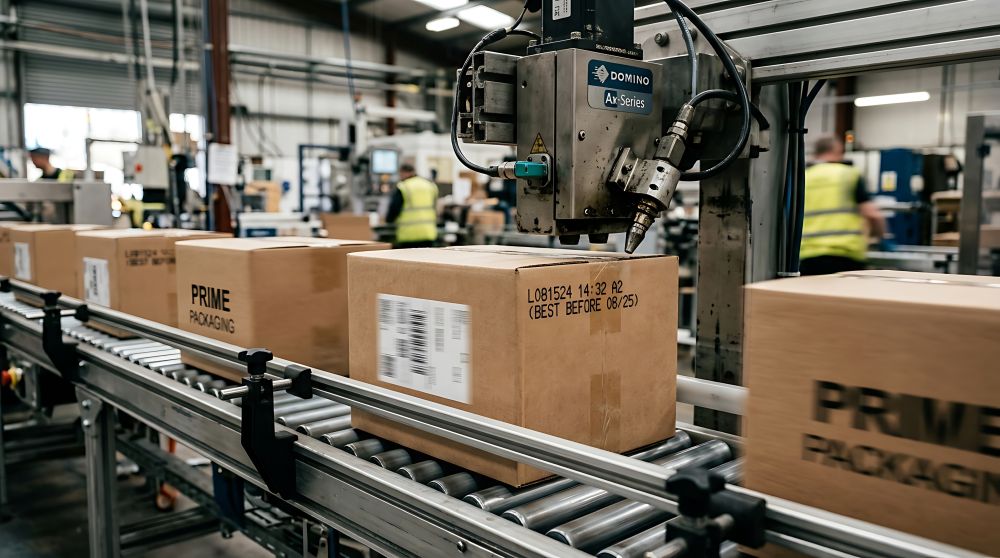
A label spends about a second being applied and then has to stay legible for the life of the product, through condensation, forklift scuffs and a year on a warehouse shelf. An automatic labeling machine is judged on both halves of that story. Speed is the part that brochures stress, yet most labelling trouble on a packaging line concerns placement, adhesion and information, so it is worth following one label from the roll to the pallet and beyond.
On the Roll
The label begins as one of several thousand on a reel of backing paper, die-cut and spaced with a small gap. That gap is how the machine knows where one label ends, so reels with uneven gaps or clear labels on clear backing need the right kind of sensor. Unwind tension has to be steady. A machine cannot rescue poor reels, and label stock should be specified alongside the applicator, with the supplier of each aware of the other.
Peeling Away
The web is pulled sharply round a thin plate. The backing follows the bend; the stiffer label does not, and it peels forward into free air, adhesive side towards the container. This simple trick is the heart of pressure-sensitive labelling. It depends on the label being released at exactly the speed the container is travelling. If the two differ, the label stretches, wrinkles or lands skewed, which is why conveyor and dispense speeds are electronically tied together.
Meeting the Container
What happens next depends on shape. A round bottle is spun against a belt or between rollers so the label wraps itself around. A flat-sided jerry can passes between two heads that apply front and back panels in one pass. A pail or drum may be rotated on the spot or labelled as it rolls past. In every case the container must arrive at a known position and spacing, so a spacing wheel or feed screw upstream matters as much as the head.
Pressed Home
A label that is merely laid on will lift. Brushes, foam rollers or a wrap belt press it down from the centre outwards to chase out air and bring the adhesive into full contact. Surfaces matter: a film of oil from filling, moisture on a cold-filled bottle or a textured moulding will all weaken the bond. When discussing automated label application systems, describe the state of the container at the labelling point, not just its dimensions.
Printed at the Last Moment
Some information cannot be pre-printed: batch number, date, net weight, a barcode for that pallet. A thermal transfer printer mounted on the head can add these as each label is dispensed, or a print-and-apply unit can produce the whole label on demand. Linking the printer to the line controller, or to the filling scale, means the data is entered once. Hand-keyed dates on a separate coder are a familiar source of recalls.
Hazard Labels Leave No Margin
On chemical containers the label is a legal document. The Globally Harmonised System sets out pictograms, signal words and hazard and precautionary statements, and national rules add details such as minimum label size and language. A hazard diamond that is creased, half-covered or on the wrong drum is a compliance failure. Consistent machine placement, combined with a scanner that confirms the right label is on the right product, removes most of that exposure.
Checked Before It Leaves
Just after application, a sensor or camera can confirm that a label is present, roughly square and, if required, that its barcode reads. Containers that fail are diverted. This check is inexpensive compared with the cost of an unlabelled drum reaching a customer or a mislabelled food pack reaching a shop. It also gives early warning: a run of rejects usually means a reel is ending, a sensor is dirty or the conveyor has been knocked out of line.
The Next Product Arrives
Mid-morning the line changes from one-litre bottles to five-litre cans. The label reel is swapped, guide rails moved, head height and angle reset. On a well-designed machine these adjustments have scales or counters and the settings for each product are saved, so the operator dials in known values. The first container should be right. Machines that rely on trial and error at each change waste labels, containers and a quarter of an hour that adds up across a week.
How Fast Is Fast Enough
A labeller does not need to be the quickest machine on the line, only a little quicker than the filler and capper feeding it. Buying speed beyond that adds cost and, often, sensitivity to variation in containers. What does raise real output is uptime: a second reel holder for quick splicing, a low-label warning, and easy access to clear a web break. Ask about these before asking for the top rate.
Judging the Whole Journey
Send suppliers your containers filled and in the condition they reach the labelling point, along with your actual label reels. Ask for a sustained run, not ten showpieces, then scuff, chill and store the samples to see how the labels hold. Check print quality, placement tolerance and the reject function. An automatic labeling machine chosen on that evidence will be fast enough, and it will also keep the label where it belongs long after the pallet has left.